Contact Us
The Parents' Corner:
Insights, Advice, and Inspiration

What Does It Really Mean When a Child Is ‘1–2 Years Behind’ in Math (and How Can We Fix It Without Starting Over)?
A parent-friendly guide to understanding math gaps, acceleration, and catching up without stress.
You’ve probably heard someone say, “Your child is one or two years behind.”
That phrase can sound like a disaster, but let’s talk about what it really means. Grab your coffee, and let’s unpack this together.
What Does “1–2 Years Behind” Actually Mean in Math?
When schools say a student is a grade or two behind, it often comes from a grade-equivalent score on a test.
Here’s the thing: that score doesn’t mean your child should go back to that earlier grade. It just compares your child’s score to the average score of students in other grades.
So, if a sixth grader gets a “4.8” on a math assessment, it means they scored similarly to the average fourth grader in the eighth month of school. It’s not a diagnosis. It’s a snapshot.
What it really tells us: a few math skills are missing, and we can find and fix them. Think of it as patching holes in a wall, not tearing the whole thing down.
Can Kids Who Are Behind Really Catch Up?
Yes. And much faster than most people think.
Research from organizations like J-PAL North America and The Annenberg Institute shows that short, frequent tutoring sessions (three to four per week) are among the most effective ways to help students close learning gaps.
You don’t need marathon sessions or extra hours of homework. Instead, focus on:
Short, consistent bursts of learning
Immediate feedback
Targeted skill review connected to grade-level content
With this approach, students often make a year’s worth of growth in just one semester.
Should We Go Back a Grade or Stay and Catch Up?
Many parents ask, “If my child is behind, shouldn’t we go back and redo earlier work?”
It’s a fair question. But most of the time, the answer is to stay in the current grade and use learning acceleration.
Learning acceleration means introducing current grade-level topics while teaching any missing skills right before they’re needed. This “just-in-time” support helps students keep up while catching up.
For example:
If a seventh grader is working on ratios but struggles with division, we’ll review division briefly before tackling ratios. That small step keeps them moving forward instead of circling back for months.
Studies from TNTP and WestEd found that students who received this kind of grade-level acceleration learned more and felt more confident than those pulled back into heavy remediation.
When should you consider a more foundational review?
If your child still struggles with core operations like multiplication or fractions.
If they can’t access current material, even with support.
If consistent tutoring hasn’t made progress after eight to twelve weeks.
Repeating a grade, however, is a last resort. Research shows it can lead to short-term improvement but lower long-term motivation and graduation rates.

What Does a Practical Catch-Up Plan Look Like?
Here’s what a six-week math catch-up plan can look like:
1. Find the Gaps
Start with a quick skill check covering operations, fractions, ratios, and equations. It doesn’t need to be a long test—just enough to pinpoint what’s missing.
2. Sort the Skills
Group them into Now, Next, and Later.
Now: Skills blocking current lessons.
Next: Skills needed soon.
Later: Extra practice to strengthen foundations.
3. Keep Sessions Short and Steady
Aim for 25–35 minutes, three or four times a week. Shorter sessions work best, especially for students with ADHD or short attention spans.
4. Mix Old and New Skills
Mix in review problems with new material. This helps the brain make connections and keeps learning fresh.
5. Measure Progress Every Two Weeks
Check not just test scores but independence. Is your child solving problems with less help? That’s progress.
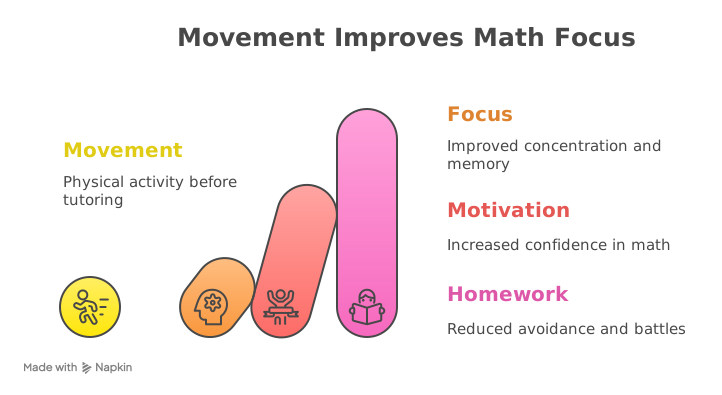
6. Add Movement and Brain Breaks
Research shows that even a few minutes of movement before tutoring improves focus and memory. Try jumping jacks, stretching, or a quick walk before math time.

What Can I Do as a Parent This Week?
Two short practices beat one long one. Fifteen minutes after school and fifteen after dinner work wonders.
Track small wins. A visible progress chart builds motivation.
Ask thinking questions. “How did you figure that out?” or “Is there another way to solve it?” These encourage reasoning over rote memorization.
What Happens If We Don’t Intervene?
When gaps go unaddressed, they stack up.
Math especially builds like a staircase—each skill depends on the last.
But once you start closing those gaps, confidence grows fast. Students begin to see that they can do this. They stop avoiding math homework, and you’ll notice fewer homework battles.
That shift in mindset often happens long before the test scores rise.
How Can We Build Confidence While Catching Up?
“1–2 years behind” isn’t a label—it’s a roadmap.
It tells us where to focus, not where to retreat.
Your child doesn’t need to start over; they need a plan that works with where they are today. With the right structure, steady encouragement, and consistent sessions, catching up is completely possible.
If you’d like help building that plan for your child, let’s chat.
About the Author
Jennifer “Coach Jen” Jones is the founder of Joy’s Educational Services in Palm Coast, Florida. With more than 15 years in education and youth development, she helps 4th through Algebra 1 students fill learning gaps, rebuild confidence, and discover that math can make sense.
References
TNTP. Accelerate, Don’t Remediate: New Evidence from Elementary Math Classrooms. May 2021. Retrieved from tntp.org
Kraft, M. A., Schueler, B. E., & Falken, G. (2024). What Impacts Should We Expect from Tutoring at Scale? Annenberg Institute at Brown University / EdWorkingPaper.
Nickow, A., Oreopoulos, P., & Quan, V. (2020). The Impressive Effects of Tutoring on PreK-12 Learning: A Systematic Review and Meta-Analysis. NBER Working Paper No. 27476.
WestEd. High-Quality Tutoring: An Evidence-Based Strategy to Tackle Learning Loss. 2022. Retrieved from wested.org
University of Chicago Education Lab & MDRC. National Study Finds In-School High Dosage Tutoring Is Successfully Accelerating Student Learning. March 2024. Retrieved from educationlab.uchicago.edu