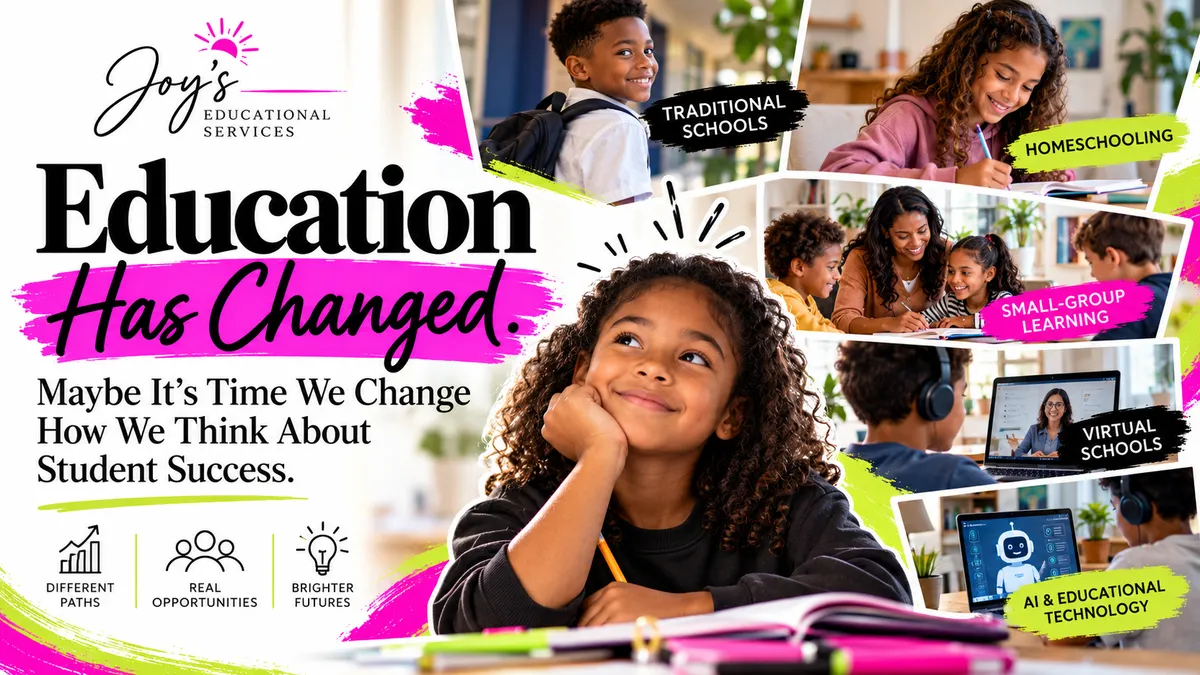
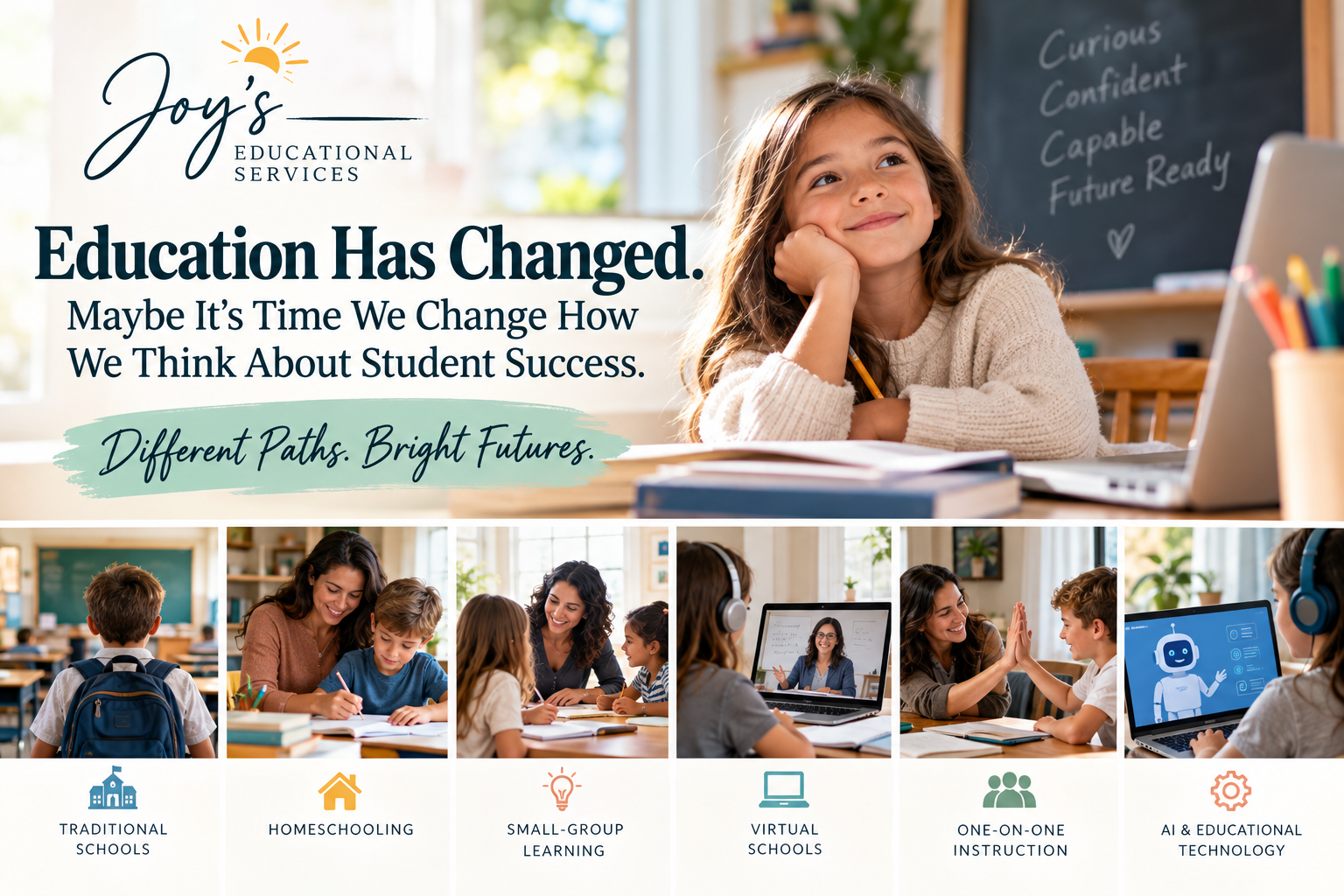
Education Has Changed. Maybe It's Time We Change How We Think About Student Success
By Jennifer Jones | Joy's Educational Services
Think about how much education has changed over the years.
Not too long ago, most families had two main choices. You either sent your child to the public school in your neighborhood or, if your family could afford it, explored private school. Homeschooling existed, but most families didn't seriously consider it.
Fast-forward to today, and the educational landscape looks completely different.
Today, we have traditional public schools, charter schools, private schools, homeschooling, virtual schools, small-group homeschool programs, hybrid programs, one-on-one instruction, and even schools that use artificial intelligence as a major part of their instructional model.
Technology has completely changed the way students learn and how educators teach. Students can attend classes from home, receive personalized instruction, work through lessons at their own pace, and access educational resources that previous generations didn't have.
Parents have more options than ever before.
But here's what I find interesting.
Even with all these options, we still spend so much time debating which type of school is better instead of asking a much more important question.
Is the child actually learning?
Not Every Child Thrives in the Same Environment
After 16 years in education, I've learned that two students can sit in the same classroom, receive the same instruction from the same teacher, and still have completely different outcomes.
One student understands the lesson the first time it's explained. The other needs to hear it three different ways before something finally clicks.
One student loves being surrounded by classmates, enjoys the daily routine, and thrives in a busy classroom. Another student may find that same environment overwhelming and struggle to concentrate.
Neither student is necessarily more capable than the other.
They simply have different needs.
And that's something I think we sometimes forget when discussing education.
Traditional schools work well for many students. They provide structure, extracurricular activities, social opportunities, and access to teachers and resources that families value.
But they don't work equally well for every student.
The same goes for homeschooling, virtual learning, private schools, and small-group programs.
No educational environment works for every child.
What Happens When Your Child Is Passing but Not Really Learning?
I think we need to have this conversation more often.
A student can earn passing grades, move up a grade level, and still have significant gaps in understanding.
I see this often in mathematics.
A student may be enrolled in seventh-grade math but still struggle with multiplication facts, fractions, or basic operations. These aren't necessarily new struggles. Sometimes they're skills they never fully mastered years earlier.
But the curriculum keeps moving.
The student moves to the next grade, and the gaps follow them.
Eventually, those gaps become harder to ignore.
Now imagine what happens when that student can slow down, revisit those foundational skills, and receive instruction that meets them where they are.
For some students, that additional support can happen right in their traditional school through teachers, intervention programs, and tutoring.
For others, a smaller or more flexible educational environment may provide the time and attention they need.
The point isn't that one environment is automatically better.
The point is that students need opportunities to master what they're learning, not just opportunities to move on to the next lesson.
Homeschooling Doesn't Look Like It Used To
One of the biggest misconceptions about homeschooling is that parents have to do everything themselves.
That may have been the reality for many families years ago, but today there are so many different ways to homeschool.
Families can use online curriculum platforms, hire tutors, enroll their children in virtual classes, join homeschool cooperatives, or participate in small-group homeschool programs.
Some parents teach every subject. Others combine several resources to create an educational experience that works for their children.
And that's one of the things I appreciate about how education has evolved.
A family can create a schedule that allows their child to participate in athletics, pursue personal interests, travel, or simply learn during the hours when they're most productive.
Of course, homeschooling also requires planning, accountability, and ensuring students have opportunities to grow academically and socially.
It isn't automatically easier, and it isn't the right fit for every family.
But for families who need something different, it's an option worth understanding.
At Joy's Educational Services, our own journey has been shaped by families seeking different kinds of educational support. What started with tutoring has grown into an in-person homeschool program that lets us work with students in a smaller, more personalized setting.
I shared more about that journey in a previous blog, Why Local Homeschool Families Are Choosing Joy's Educational Services.
Small Groups, One-on-One Learning, and the Power of Being Seen
I've always believed relationships matter in education.
When you work with a student consistently, you begin to recognize things that don't always show up on a test or report card.
You notice when they're losing confidence.
You notice when they're guessing instead of understanding.
You notice when they're capable of doing more but are afraid to make a mistake.
And you learn how to reach them.
Smaller learning environments can make it easier to recognize those things because educators may have more time to work individually with students.
But small class sizes alone don't guarantee success. The quality of instruction, expectations, relationships, and academic support still matter.
We also need to remember that personalized learning doesn't always mean slowing down.
Sometimes it means allowing a student to move ahead.
A child ready for more challenging work shouldn't have to stay at the same pace simply because of their age or grade level.
And a child who needs additional practice shouldn't feel like they're failing because they need more time.
Both deserve an education that challenges and supports them appropriately.
Now We're Talking About AI Schools
If you had told me years ago that artificial intelligence would become part of everyday classroom instruction, I probably would have had a lot of questions.
And I still do!
But there's no denying that technology has created opportunities that educators and families didn't have before.
Today, students can use adaptive learning programs that adjust practice based on their performance. Teachers can access information about student progress much faster, and families can find educational resources with just a few clicks.
We're also beginning to see educational models that rely heavily on AI-supported instruction.
I think these developments are worth paying attention to.
At the same time, I don't believe we should assume that something is better simply because it's newer or uses more technology.
We still need to ask whether students understand the material, develop critical-thinking skills, receive appropriate support, and build meaningful relationships.
Technology can identify that a student answered a question incorrectly.
But understanding why that student is struggling may require a conversation, encouragement, observation, or a completely different approach to teaching the concept.
Technology should help us improve education, not distract us from what education is supposed to accomplish.
What About Socialization?
This is probably one of the most common concerns families have when considering alternatives to traditional schooling.
Will my child have friends? Will they know how to interact with others? Will they miss out on important experiences?
Those are fair questions.
Traditional schools give students daily opportunities to interact with peers, join group activities, and build friendships.
But those opportunities aren't limited to traditional schools.
Homeschool students may participate in sports, clubs, community programs, field trips, cooperative classes, volunteer activities, and other social experiences.
The important thing is making sure those opportunities actually exist.
A child attending a smaller learning program may benefit from closer relationships and more individual attention, while another child may prefer the larger social environment of a traditional school.
Again, it comes back to knowing your child and understanding what they need.
Sometimes the Best Choice for One Child Isn't the Best Choice for Another
Here's something else I think parents should consider.
Just because two children grow up in the same household doesn't mean they need to attend the same type of school.
One child may thrive in a traditional classroom while their sibling needs a more flexible environment.
One may enjoy virtual learning while the other needs face-to-face instruction.
Sometimes the environment that worked for a child in elementary school may not fit as well in middle or high school.
That's okay.
Educational decisions don't always have to be permanent.
As children grow, their academic needs, interests, and personalities change. Families should feel comfortable reevaluating their choices.
We do this in so many other areas of our lives. We adjust activities, schedules, and routines as our children grow.
Why should education be any different?
The Best Educational Choice Also Has to Work for Your Family
We can't talk about educational options without acknowledging that families have different circumstances.
Parents have jobs, responsibilities, financial considerations, transportation challenges, and schedules that shape their decisions.
Some families need the consistency of a traditional school day. Others need more flexibility because of work, athletics, travel, or other family commitments.
Some parents have the time and resources to manage homeschooling independently. Others need outside educators or structured programs to make that possible.
Not every educational option is accessible or affordable for every family.
These things matter.
Choosing an educational environment isn't just about finding a program that looks good on paper.
It's about finding something that supports your child's needs while also being realistic and sustainable for your family.
Fortunately, families today have more opportunities to explore different arrangements, even if access varies.
So What Does Student Success Really Look Like?
I think we need to change the conversation here.
We've become so accustomed to measuring success through grades, test scores, grade-level placement, and graduation rates.
And while those measurements matter, they don't tell the whole story.
Sometimes success is a student finally understanding a concept they've struggled with for years.
Sometimes it's a child who once hated reading, then voluntarily picks up a book.
Sometimes it's a student who was afraid to ask questions, finally feeling comfortable enough to say, "I don't understand."
And sometimes success is a student who has always performed well academically, finally finding an environment that challenges them to reach their full potential.
We have to recognize that success doesn't always look the same.
The student who thrives in a traditional public school deserves celebration.
So does the student who thrives in a homeschool program, charter school, private school, virtual school, or another learning environment.
The goal should never be to prove that one type of education is superior to every other option.
The goal should be to help students become capable, confident learners who are prepared for whatever comes next.
Education Has Changed. Our Thinking Should Too.
I love that families have more choices today.
I love that technology has opened doors for students who may have struggled in traditional settings.
And I love that we're having more conversations about individualized learning, academic foundations, and what students actually need to be successful.
But we also have to be careful not to turn educational choice into another competition.
Traditional school versus homeschool.
Public versus private.
Virtual versus in-person.
AI versus teachers.
Maybe instead of spending so much time deciding which educational model is best, we should spend more time asking which environment best fits the individual child.
Because a student's success shouldn't be defined by the name of the school they attend or the type of educational program their family chooses.
It should show in their growth, understanding, confidence, and preparation for the future.
At Joy's Educational Services, that's what we focus on every day. We meet students where they are, build strong academic foundations, and help them move forward with confidence.
Whether your child attends traditional school, is homeschooled, or learns in a different setting, I encourage you to look beyond the label.
Look at the child.
Are they learning? Are they growing? Are they being challenged and supported?
Those are the conversations worth having.
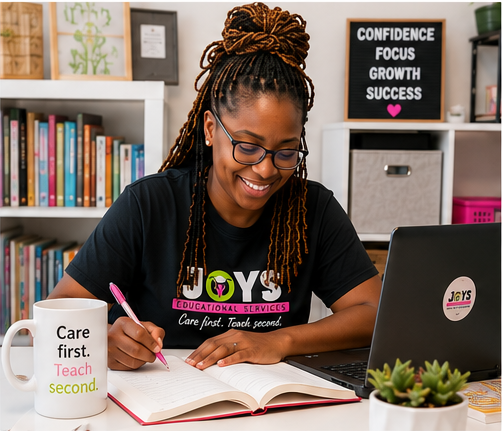
Care first. Teach second.
Jennifer Jones
Founder, Joy's Educational Services
www.joyseducationalservices.org