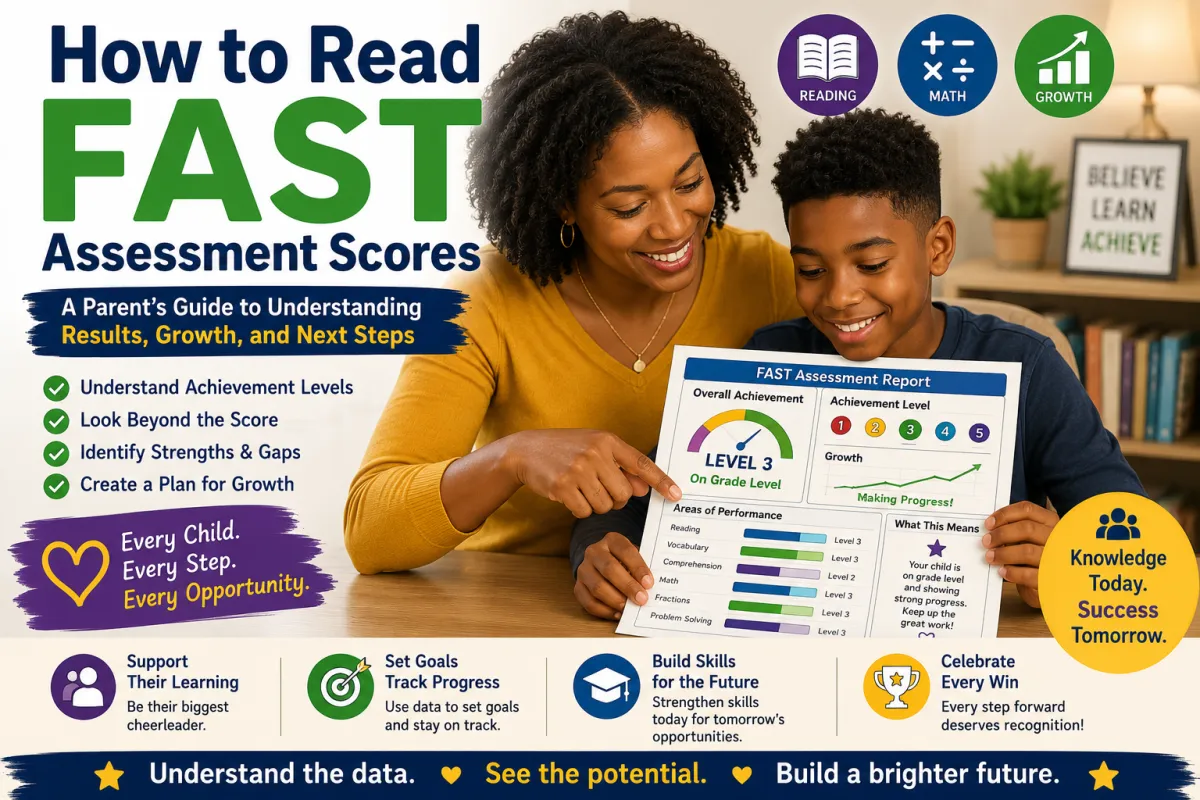
How to Read FAST Assessment Scores: A Florida Parent's Guide to Understanding Your Child's Results
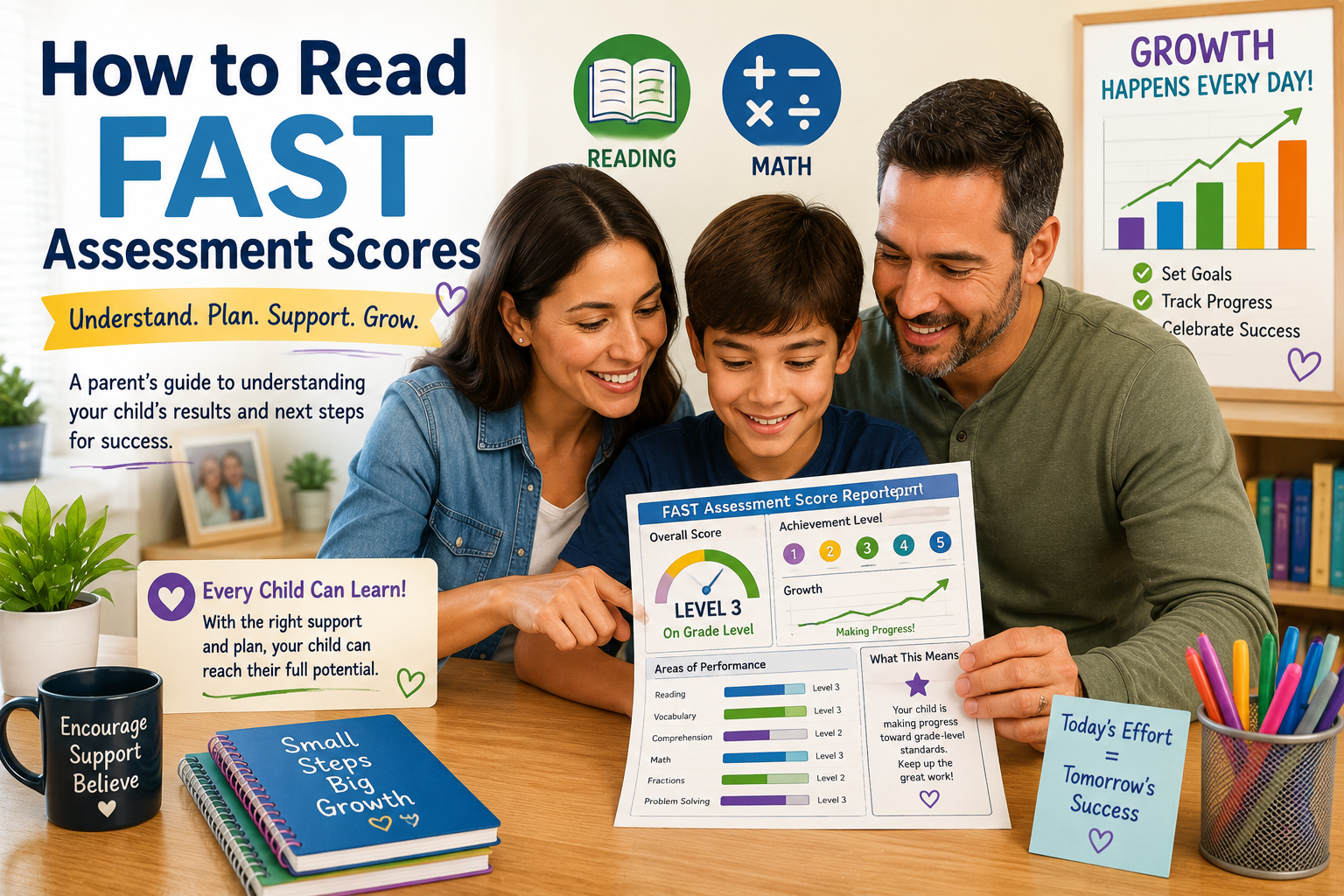
Your child just brought home their FAST Assessment scores.
You open the report and immediately see numbers, charts, achievement levels, and terms that may not mean much at first glance.
Naturally, questions start racing through your mind:
Is this score good?
Is my child on grade level?
Should I be worried?
What should we work on next?
How can I help my child improve?
If you've ever felt overwhelmed looking at a FAST score report, you're not alone.
As a former classroom teacher and educational consultant, I've helped many families understand their child's assessment results. One thing I always tell parents is this:
A score is simply information. What you do with that information is what matters most.
Let's break it down together.
What Is the FAST Assessment?
FAST stands for Florida Assessment of Student Thinking.
It is Florida's statewide assessment used to measure student progress in Reading and Mathematics.
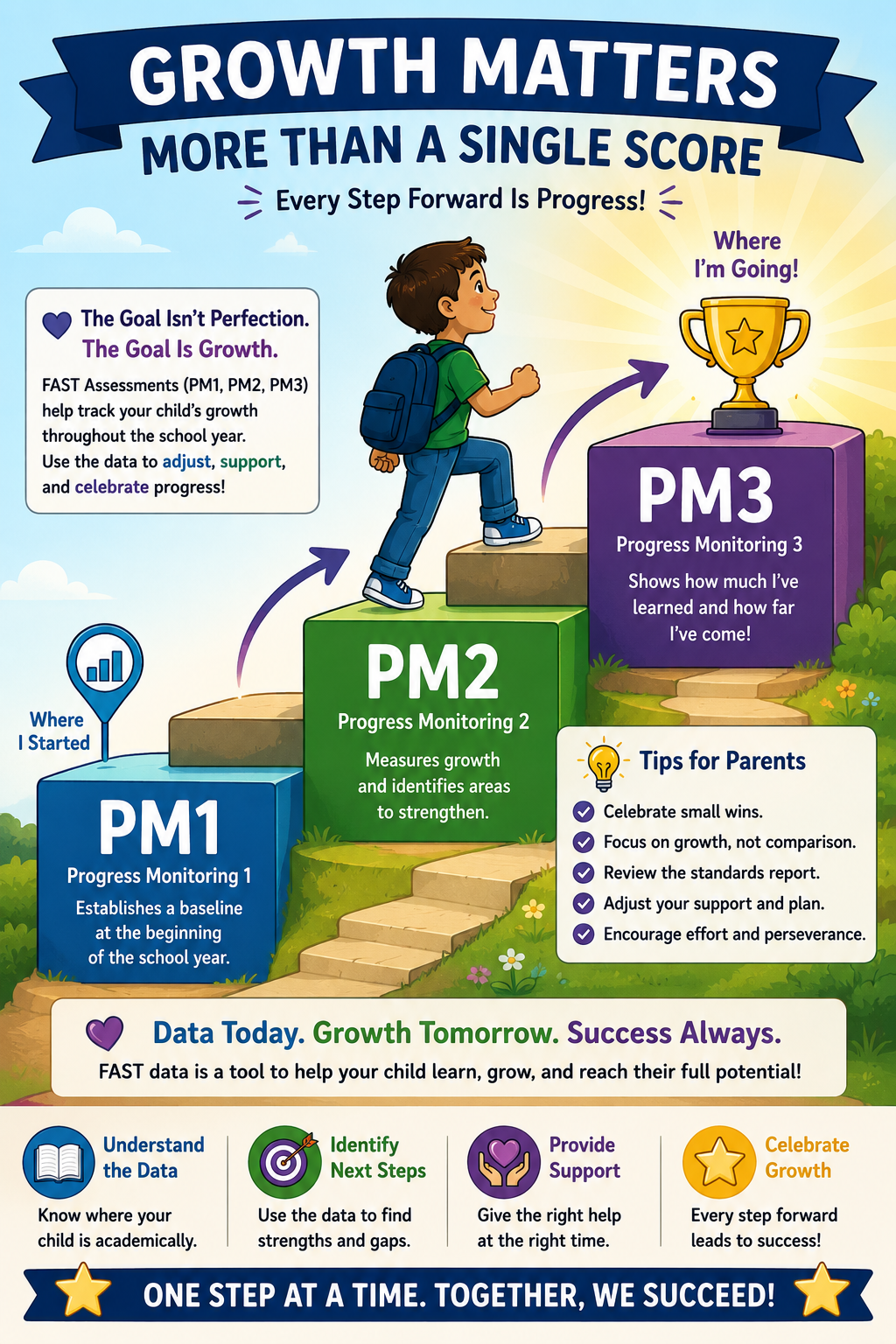
Students typically take the FAST assessment three times throughout the school year:
PM1 (Progress Monitoring 1)
Administered near the beginning of the school year to establish a baseline.
PM2 (Progress Monitoring 2)
Administered during the middle of the school year to measure growth.
PM3 (Progress Monitoring 3)
Administered near the end of the school year to determine mastery of grade-level standards.
Unlike older assessments that relied on one final test, FAST is designed to measure growth throughout the year.
Understanding FAST Achievement Levels
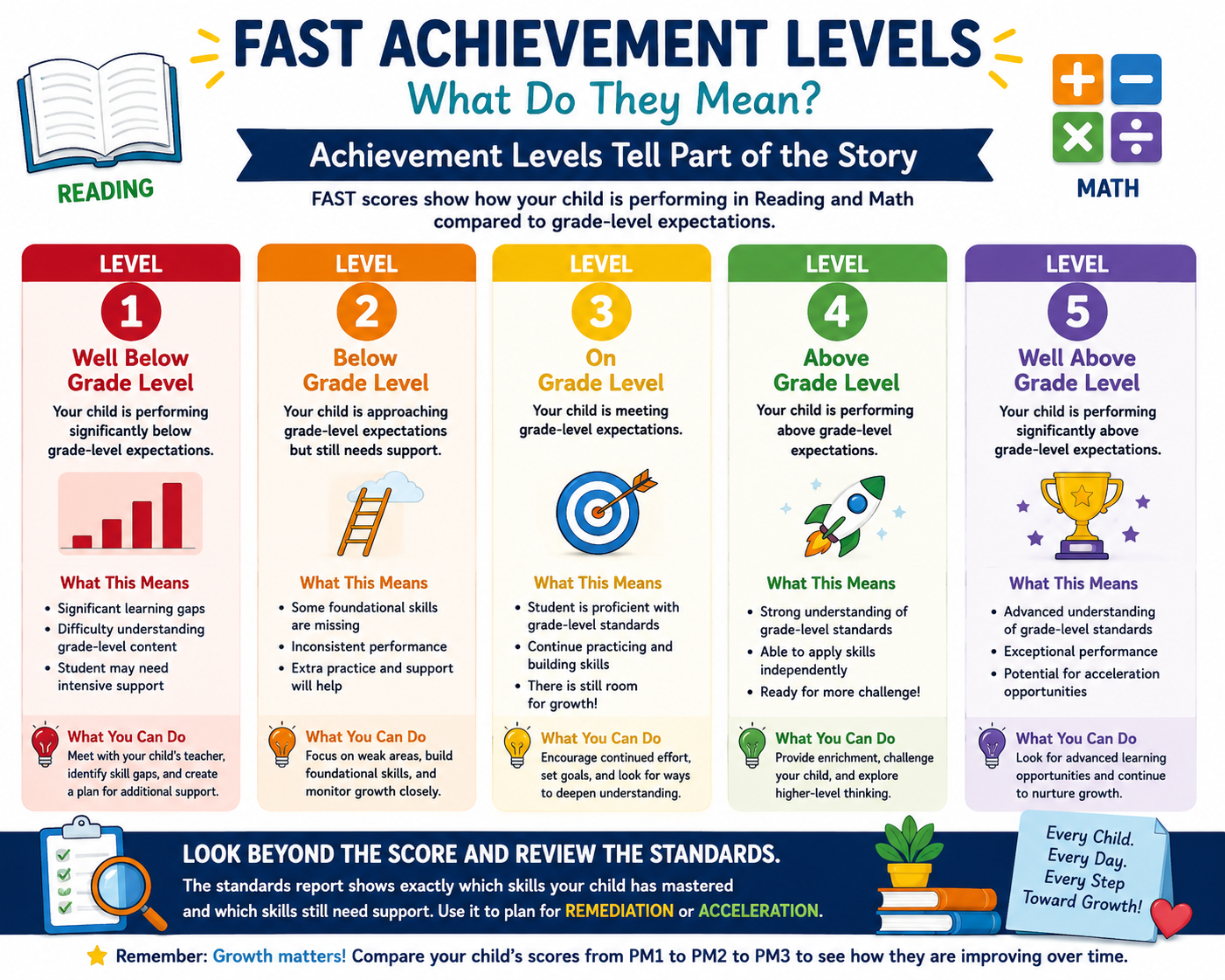
FAST scores are grouped into five achievement levels.
Level 1: Well Below Grade Level
Students performing at Level 1 are significantly below grade-level expectations.
Potential Red Flags
🚩 Significant learning gaps
🚩 Difficulty accessing grade-level content
🚩 Weak foundational skills
What Parents Should Do
✔ Schedule a conference with your child's teacher
✔ Identify specific skill gaps
✔ Develop a targeted intervention plan
✔ Consider additional academic support
Level 2: Below Grade Level
Students are approaching proficiency but still need support.
Potential Red Flags
🚩 Inconsistent performance
🚩 Difficulty applying skills independently
🚩 Missing foundational concepts
What Parents Should Do
✔ Review weak standards
✔ Practice skills consistently
✔ Monitor growth carefully between testing periods
✔ Create a plan for remediation
Level 3: On Grade Level
Students are meeting grade-level expectations.
What Parents Should Know
Many parents celebrate a Level 3 and move on.
While Level 3 indicates proficiency, it doesn't necessarily mean your child has mastered every standard.
Ask yourself:
Is my child barely meeting expectations?
Is there room for growth?
Which standards still need strengthening?
Level 4: Above Grade Level
Students demonstrate a strong understanding of grade-level standards.
What Parents Should Do
✔ Continue challenging your child
✔ Provide enrichment opportunities
✔ Encourage higher-level thinking
✔ Introduce advanced concepts when appropriate
Level 5: Well Above Grade Level
Students are significantly exceeding grade-level expectations.
What Parents Should Do
✔ Consider acceleration opportunities
✔ Explore advanced coursework
✔ Continue nurturing academic growth
Don't Stop at the Overall Score: Look at the Standards
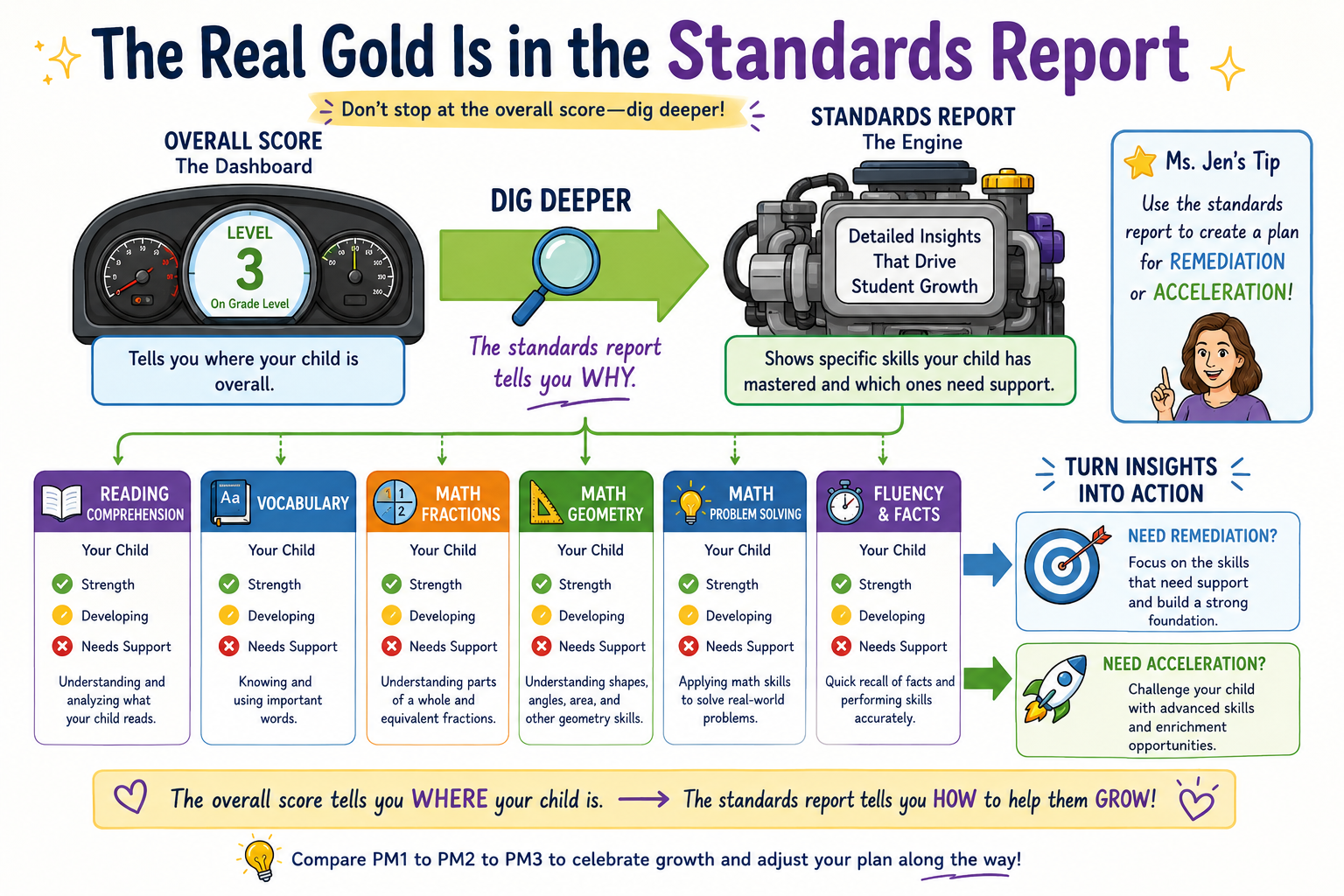
This is where many parents miss the most valuable information.
One of the biggest mistakes I see is focusing only on the achievement level.
The real gold is in the standards report.
FAST assessments measure specific Florida B.E.S.T. Standards.
Your child's report provides clues about which skills they have mastered and which skills still need support.
Instead of asking:
"Did my child pass?"
Start asking:
"What specific skills has my child learned?"
and
"What specific skills does my child still need to learn?"
Step 1: Find Your Grade-Level Curriculum Guide
Florida publishes grade-level B.E.S.T. Standards for every subject.
These guides tell you exactly what students are expected to learn throughout the year.
Reviewing these standards helps parents understand where their child is academically.
Step 2: Determine What Has Already Been Taught
This is incredibly important.
Not every standard has been taught when students take PM1 or PM2.
For example:
A student taking PM2 may be tested on standards covered in the first half of the year, even if some standards haven't yet been introduced.
Before becoming concerned about a weak area, ask:
Has this skill already been taught?
Is this a current skill?
Is this a skill that will be taught later in the year?
Context matters.
Step 3: Identify Learning Gaps
Look for standards where your child consistently struggles.
These often reveal learning gaps that need remediation.
Examples may include:
Reading comprehension
Vocabulary
Fractions
Multiplication fluency
Geometry
Algebraic thinking
Problem-solving skills
When you identify the exact skill causing difficulty, you can stop guessing and start helping.
Step 4: Decide Whether Your Child Needs Remediation or Acceleration
This is where FAST data becomes powerful.
If Your Child Is Struggling
Focus on remediation.
Ask:
Which standards need reteaching?
Which foundational skills are missing?
What resources can strengthen these skills?
If Your Child Is Excelling
Focus on acceleration.
Ask:
Which standards can we preview early?
Can my child handle more challenging work?
Are there enrichment opportunities available?
The goal isn't simply to raise a score.
The goal is to help your child continue growing.
💡 Ms. Jen's FAST Assessment Tip
When you receive your child's FAST scores, don't just look at the achievement level and move on.
Pull up your child's standards report and compare it to the grade-level curriculum map.
Ask yourself:
✔ Which standards has my child mastered?
✔ Which standards are still developing?
✔ Which standards haven't been taught yet?
✔ Do we need remediation or acceleration?
The goal isn't just to know your child's score.
The goal is to create a plan.
A score is simply data. What you do with that data is what drives growth.
What Are the Biggest Red Flags?
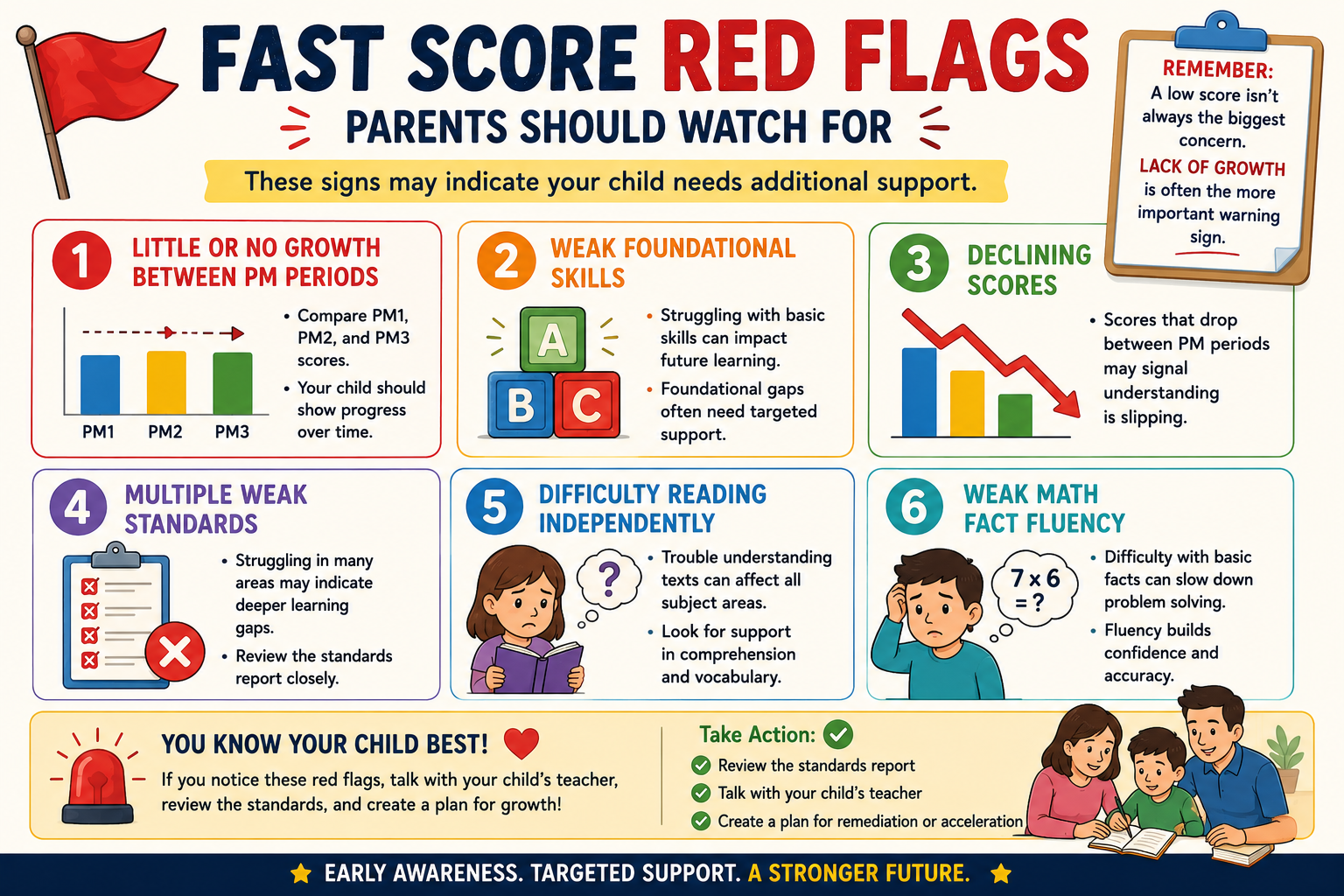
Here are the signs I encourage parents to pay attention to:
🚩 Little or no growth between PM1, PM2, and PM3
🚩 Declining scores
🚩 Multiple weak standards
🚩 Difficulty reading independently
🚩 Weak math fact fluency
🚩 Strong classroom grades but weak assessment scores
🚩 Low academic confidence
Remember:
A low score is not a red flag.
A lack of growth is often the bigger concern.
Questions to Ask During Your Parent-Teacher Conference
If you're meeting with your child's teacher, consider asking:
Which standards is my child strongest in?
Which standards need additional support?
Is my child showing expected growth?
Are there any foundational skills missing?
What should we practice at home?
Would my child benefit from intervention?
Would my child benefit from enrichment or acceleration?
These conversations can provide valuable insight beyond what the score report shows.
How to Help Your Child Improve FAST Scores
For Reading
✔ Read daily
✔ Discuss what was read
✔ Build vocabulary
✔ Practice comprehension skills
✔ Use resources like ReadTheory
For Math
✔ Strengthen foundational skills
✔ Practice math facts regularly
✔ Focus on problem-solving
✔ Use IXL or Khan Academy
✔ Review weak standards consistently
Small, consistent practice often produces the biggest results.
What FAST Scores Don't Tell You
This may be the most important section of this article.
FAST scores provide valuable information.
But they do not measure:
Creativity
Leadership
Determination
Character
Work ethic
Kindness
Resilience
A FAST score is a snapshot.
It is not your child's future.
Use the score as a tool—not a label.
My Final Advice to Parents
Don't chase the score.
Understand the score.
The real purpose of FAST data isn't to compare your child to other students.
It's to identify strengths, uncover learning gaps, and create a plan moving forward.
Every child can learn.
Some children need remediation.
Some need acceleration.
Some need confidence.
Most need a plan.
When parents understand what the data is telling them, they can become powerful advocates for their child's success.
Need Help Understanding Your Child's FAST Scores?
If you're unsure how to interpret your child's FAST Assessment report, I'd love to help.
During a FREE consultation, we'll review your child's scores, identify strengths and weaknesses, examine the standards report, and create a personalized growth plan.
At Joy's Educational Services, we believe every child can learn. Sometimes they need the right plan, the right support, and someone who believes in them.
👉 Schedule Your FREE Consultation:
https://joyseducationalservices.org/home
Because every child deserves an education designed for them—not a one-size-fits-all system.
Frequently Asked Questions
What FAST score is considered passing?
Students typically need to score at Level 3 or higher to demonstrate grade-level proficiency.
Is a Level 2 FAST score bad?
Not necessarily. It indicates that additional support may be needed, but many students make significant growth through targeted instruction and intervention.
How often do students take the FAST Assessment?
Most students participate in PM1, PM2, and PM3 throughout the school year.
Should I focus on the achievement level or standards?
Both matter, but the standards report often provides the most useful information because it identifies specific skills your child has mastered and skills that still need support.
Can tutoring improve FAST scores?
Yes. When tutoring focuses on learning gaps, foundational skills, and targeted standards, students often improve both their academic performance and confidence.
About the Author
Jennifer Jones is the founder of Joy's Educational Services, a Florida educator, homeschool consultant, and former classroom teacher with more than 16 years of experience helping students build confidence and achieve academic success.
Throughout her career, Jennifer has worked with students performing significantly below grade level, helping many improve their FAST Assessment performance and reach Level 3 proficiency or higher through personalized learning plans, targeted intervention, and consistent support.
Her passion extends beyond helping students pass tests. Jennifer focuses on identifying learning gaps, building strong academic foundations, and teaching students how to become confident, independent learners.
Many of her former students have gone on to excel in advanced middle school and high school coursework, earn high school credits early, graduate successfully, attend college, enter skilled careers, and pursue their long-term goals with confidence.
Through tutoring, homeschool support, educational consulting, and scholarship guidance, Jennifer partners with families to create customized learning plans that help students thrive academically and beyond.
Her philosophy is simple:
Every child can learn. Sometimes they need the right plan, the right support, and someone who believes in them.