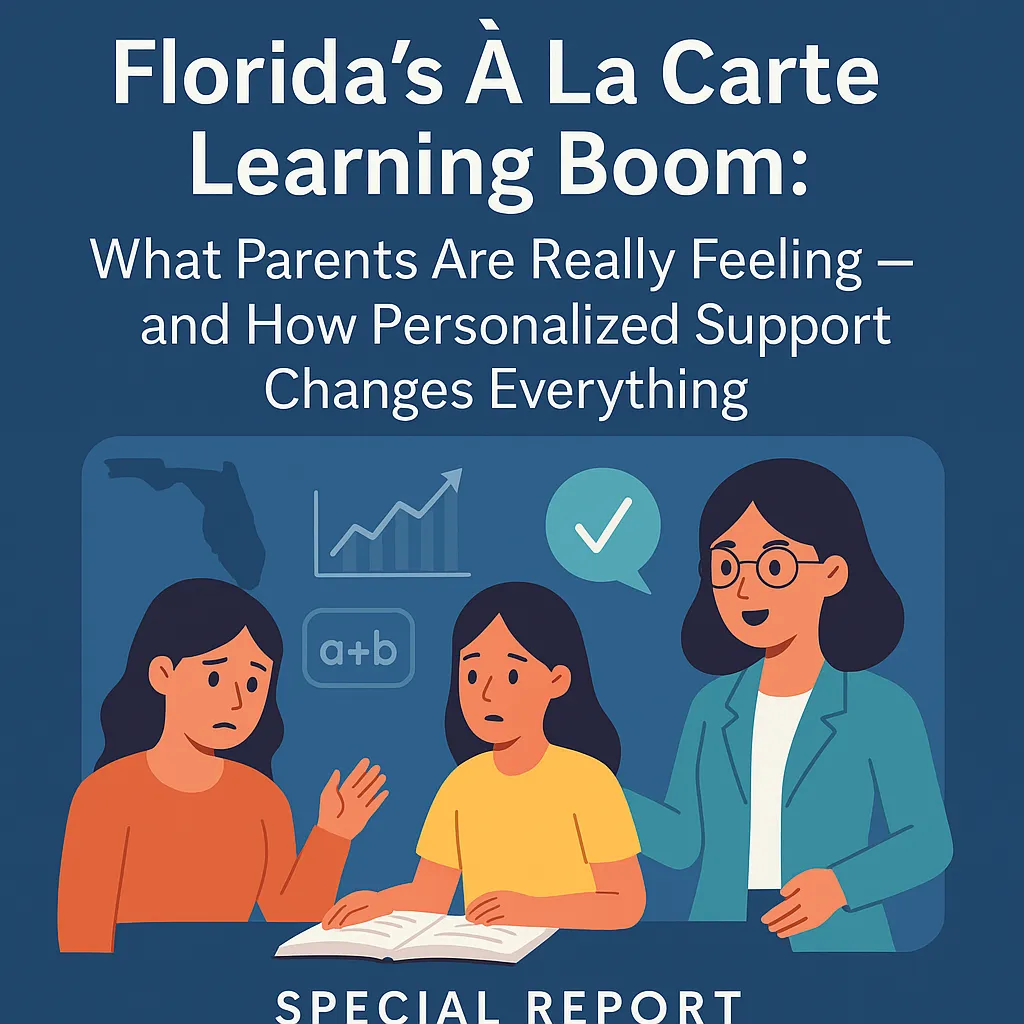
Florida’s À La Carte Learning Boom: What Parents Are Really Feeling — and How Personalized Support Changes Everything
If you are a parent in Florida right now, you are probably feeling the weight of how much education has changed. Classrooms feel different. Teachers are stretched thin. Students need more academic support than ever. Parents are working harder to fill gaps that schools no longer have the capacity to cover.
A recent report from the NextSteps Blog revealed an important finding. More than 140,000 Florida students now use a la carte learning through education savings accounts. Five years ago, fewer than 9,000 students participated. That is not a minor shift. That is a significant change in how families choose to educate their children.
Behind this, families are trying to answer a simple question.
How do I help my child get individualized academic support when the school system is overwhelmed?
Let’s walk through the fundamental questions parents are asking.
Why are so many Florida students falling behind academically?
Parents search Google every day, asking:
Why is my child struggling for the first time
Why can my child read words but not comprehend
Why did my child fall behind after COVID
Why does homework take so long
The truth is confirmed by national research.
The National Assessment of Educational Progress reports that math and reading scores remain lower than before COVID. Younger students and students with learning differences were hit the hardest.
Students missed critical foundational years.
Schools have tried to recover, but the gaps are fundamental.

Why are teachers overwhelmed and unable to give one-on-one help?
Reddit threads from both teachers and parents ask:
Why is my child not getting individual attention
Why does my child’s teacher seem stressed
What is causing burnout in schools
Why is there so much turnover
The RAND Corporation’s 2024 report explains it clearly. Teachers are managing larger classes with fewer resources and higher emotional needs. Many teachers are leaving the profession. Those who stay are doing the best they can, but individualized instruction is limited by time and capacity.
Parents are not imagining it. Teachers want to help, but the system is overloaded.
Are COVID learning gaps still affecting students in 2025?
Parents often say:
“My child never caught up from COVID.”
And they are correct.
Research shows that learning loss was not a short-term issue. Students with disabilities, minority students, and low-income students were disproportionately affected. Executive functioning skills also declined. Attention spans shortened. Reading comprehension slowed. Math fluency dropped sharply.
These challenges require structured intervention, not guesswork.

Why do minority students and students with disabilities need more individualized support?
The Learning Policy Institute reports that schools serving minority and low-income communities often face:
Larger class sizes
Less intervention staffing
More teacher turnover
Fewer advanced opportunities
Fewer consistent academic supports
Families see the effects.
Students feel the impact.
Students with dyslexia, ADHD, autism, and processing delays often do not receive enough targeted support. Evaluation backlogs are long. Intervention time is limited. Parents find themselves searching for outside help.

What is a la carte learning, and why is it growing in Florida?
A la carte learning means families can choose individual services to build their own educational plan. Instead of one system providing everything, parents can assemble a team that meets their child’s needs.
Florida ESAs make this possible.
Parents can use funds to access:
Tutoring
Therapies
Curriculum
Microschools
Online learning
Academic support
This flexibility allows families to get the exact help their child needs.

How can parents know what kind of academic support their child needs?
Parents frequently ask:
Where do I start
Does my child need reading help
Is it attention
Is it confidence
Are they foundational skills
This is where personalized evaluation and targeted tutoring become essential.
Students need structured support, not random worksheets or generic homework help.
At Joy’s Educational Services, this starts with understanding:
IXL diagnostics
Strengths and challenges
Gaps in foundational skills
Learning style
Confidence level
Executive functioning needs
Families walk away with clarity and a plan.

How does Joy’s Educational Services help struggling students?
Here is what makes JES different.
1. Instruction tailored to each student
Every lesson is designed intentionally using BEST standards, IXL data, and skill pathways.
2. Filling the gaps that schools cannot always cover
Students get individual time, repetition, structure, and consistency.
3. Culturally responsive support for minority learners
Students feel seen, valued, and understood.
4. Support for dyslexia, ADHD, autism, and learning differences
Instruction is multisensory, structured, visual, and confidence-building.
5. ESA guidance made simple
Families get help understanding funding, choosing services, creating plans, and tracking progress.
Parents consistently say:
“My child is finally making progress.”
“My child understands things for the first time.”
“You gave us direction when we had none.”
“My child’s confidence has returned.”
This is the heart of personalized learning.
How can ESAs help families access customized tutoring?
ESAs give families the ability to use state funds for:
Tutoring
Learning programs
Curriculum
Therapy
Educational supports
Parents no longer have to wait for schools to have resources.
They can build their own individualized learning pathway with support from providers like JES.

Ready to take the next step?
You do not have to navigate Florida’s changing education landscape alone.
Your child deserves a plan made just for them.
Book Your Free Academic Consultation
Let’s discuss your child’s needs, strengths, and goals.
Want help understanding ESA options?
I can walk you through the process and help you build a customized plan.
Your child’s growth is possible.
Their confidence is possible.
Their progress starts with the right plan